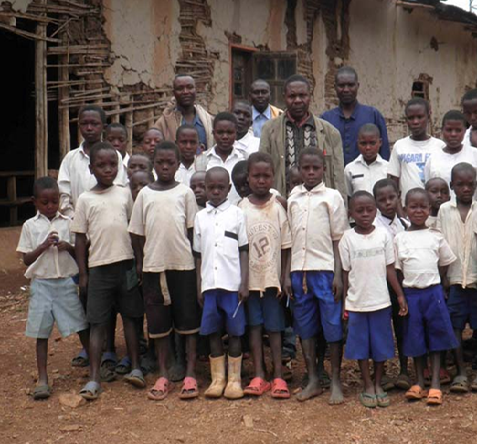
School in a state of advanced disrepair
This striking image perfectly illustrates the monumental challenges that the SOEDI department of the NPADR non-profit organization is striving to address. The advanced state of disrepair of the school building in the background, with its crumbling mud walls, testifies to an infrastructural precarity that seriously compromises the regularity of the school calendar in the face of inclement weather; a reality that places the rehabilitation of social infrastructure at the heart of the organization's Axis I.
Beyond the built environment, rural poverty is evident in the very dignity of the students: between mismatched uniforms, worn clothing, and a lack of shoes suitable for long walks in isolated areas, the lack of basic school supplies is glaring.
At the center of this picture of vulnerability, the presence of adults alongside the students takes on its full meaning: these are the teachers who, despite their utter destitution, keep the flame of education alive. These teachers, standing among their students, embody the community's roots and local acceptance of the NPADR (National Program for the Promotion of Rural Development), remaining in positions of responsibility where international organizations often withdraw.
Faced with this reality, the SOEDI department has identified a priority area for action where education must become a lever for resilience.
The urgency lies not only in rebuilding the walls, but also in supporting these dedicated teachers through psychosocial support (MHPSS) and the introduction of digital inclusion, chosen by the non-profit organization as a driver of intellectual development. In short, this image constitutes a true call to action for strengthening child protection and modernizing schools.
It justifies the organization's "localization" strategy, because only local expertise can transform this precarious situation into a model of integrated, dignified, and secure development for the youth and educators of South Kivu in the DRC.